Know4Nano Training School on Food Safety Successfully Completed at the BioSense Institute
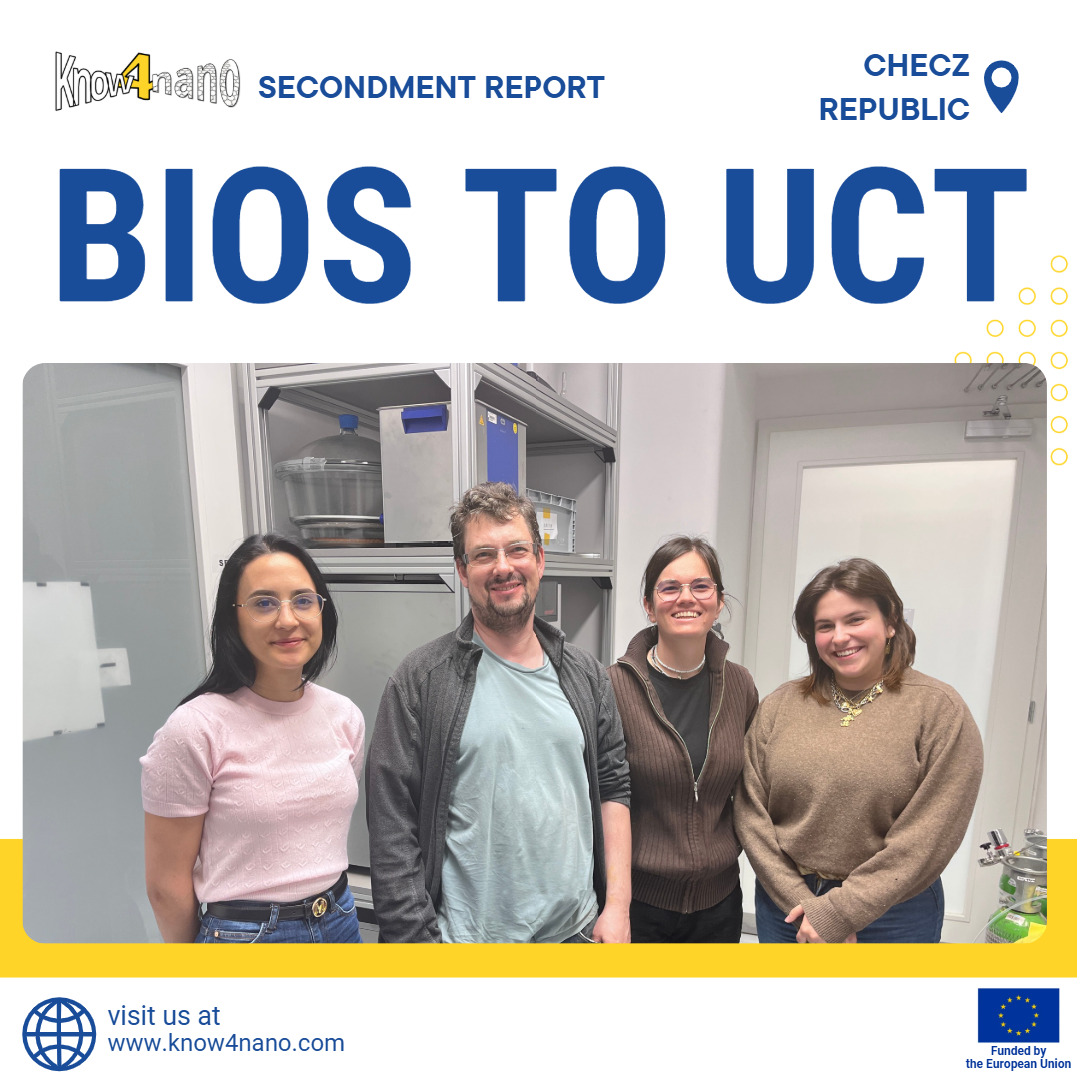
As part of the KNOW4NANO project, three researchers from the project network recently took part in extended research stays at the partner institution, University of Chemistry and Technology Prague (UCT), gaining hands-on experience in advanced nanomaterials, electrochemical sensing, and sensor fabrication.
The research secondments brought together complementary approaches to the development of next-generation sensing platforms, ranging from MXene-based electrochemical sensors and 3D-printed electrodes to 2D nanomaterial-based gas sensors. Through practical laboratory training, knowledge exchange, and collaboration with researchers at UCT, the secondments contributed to strengthening research expertise and building long-term scientific connections within the Know4Nano network.
Developing More Stable MXene-Based Electrochemical Sensors
During her one-month research stay at UCT Prague, MSc Milica Govedarica focused on the electrochemical modification of electrodes for sensor applications. Her work centred on electropolymerization and the stabilization of MXene (Ti₃C₂Tₓ), with the aim of understanding how processing and stabilization conditions influence the fabrication of reliable electrode coatings.
Through hands-on experimental work, Milica explored approaches for improving MXene stability and gained practical experience in the development of functional electrode interfaces. The work contributes to a better understanding of the conditions required for producing stable MXene-based sensing platforms with potential applications in high-performance electrochemical sensors.
Advancing 3D-Printed Electrochemical Sensors
MSc Zorica Novaković has carried out her research stay at UCT Prague with a focus on the development of advanced electrochemical sensing platforms based on 3D-printed electrodes.
Her research combined three-dimensional carbon-based electrode architectures with functional nanomaterials, including ZnO nanoparticles and TMD materials. Particular attention was given to optimizing ZnO electrodeposition and integrating WS₂ nanosheets into the 3D electrode architecture. The resulting electrodes were evaluated using cyclic voltammetry, differential pulse voltammetry, and electrochemical impedance spectroscopy to investigate their electrochemical and catalytic properties.
An additional aspect of the secondment involved training in TMD synthesis and characterization and their integration into electrochemical sensing platforms. The research team has also explored norepinephrine detection using an innovative “lab-on-a-scalpel” platform based on a three-dimensional carbon scalpel electrode modified with ZnO.
Exploring 2D Nanomaterials for Gas-Based Detection of Bacterial Metabolites
During her research stay, MScJelena Đerić focused on the development of chemiresistive gas sensors based on two-dimensional nanomaterials for the detection of bacterial metabolites.
Her work involved the synthesis, exfoliation, and deposition of transition metal dichalcogenides (TMDs), with particular attention to MoSe₂-based sensing layers. Ammonia (NH₃) was investigated as a potential metabolic indicator of bacterial activity, while nitrogen dioxide (NO₂) was used as a reactive reference gas to evaluate sensor sensitivity.
Jelena explored different approaches for sensor fabrication, including drop-casting, roll-to-roll transfer, and inkjet printing. Both pristine and chemically doped MoSe₂ materials were investigated under different humidity conditions, with the aim of improving measurement repeatability and baseline recovery.
The secondment also provided hands-on training in dynamic gas-sensing systems and electrical measurements, as well as practical experience in optimizing parameters such as operating voltage and material suspension concentration. Participation in laboratory activities and group discussions further supported the development of problem-solving skills related to sensor fabrication, electrode adhesion, and data interpretation.
Building Research Capacity Through Mobility and Collaboration
Although the three secondments addressed different sensing technologies, they shared a common goal: using advanced nanomaterials and innovative fabrication strategies to develop more reliable and sensitive sensing platforms.
The research stays enabled the participating researchers to gain practical experience with techniques and equipment not routinely available in their home research environments, while also facilitating direct knowledge exchange with researchers at UCT Prague. From MXene stabilization and 3D-printed electrochemical electrodes to TMD-based gas sensing, the secondments demonstrate the value of international mobility in expanding technical expertise and encouraging interdisciplinary collaboration.