Revolutionizing MXene Production
In the world of 2D materials, MXenes are the rising stars. Known for their exceptional conductivity and energy storage capabilities, they hold the key to the next generation of supercapacitors and sensors. However, there has always been a “bottleneck” in the lab: the synthesis process. Traditional etching of MAX phases can take hours or even days, often requiring complex post-processing steps.
The Know4Nano team decided it was time to change the tempo.
The Breakthrough: 500x Faster
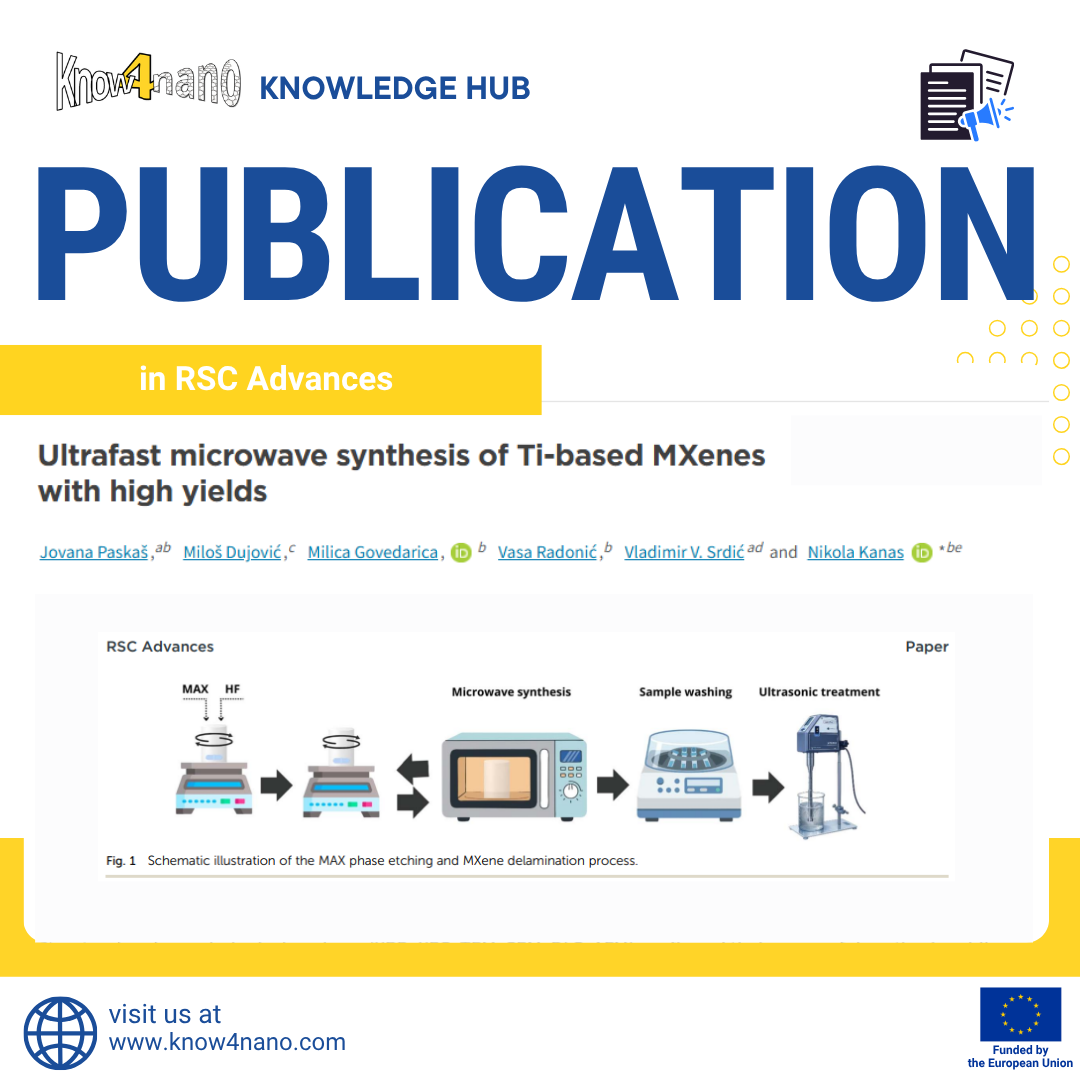
In our latest study published in RSC Advances, our researchers unveiled a microwave-assisted synthesis method that is nothing short of transformative. By utilizing microwave radiation at 220 W, the team achieved successful etching of Ti3AlC2 and Ti3AlCN in just 3 minutes.
Compared to conventional methods, this represents a ~500-fold acceleration in production speed.
High Yields, Lower Effort
Speed isn’t the only advantage. This ultrafast method delivers high-purity results, with yields reaching approximately 90% for Ti3C2 and 70% for Ti3CN.
But here is the real “magic” of the microwave: the rapid heating causes a vigorous evolution of hydrogen gas within the material. This internal pressure pushes the layers apart, creating an expanded, “accordion-like” structure. Because the structure is already so well-expanded, the team was able to delaminate the MXene into individual flakes using only mild ultrasonication—completely eliminating the need for post-synthesis intercalation.
What This Means for the Future
Efficiency is the bridge between a laboratory discovery and an industrial application. By proving that microwave-synthesized MXenes perform just as well as those made via traditional methods, the Know4Nano team has provided a blueprint for scalable, rapid, and cost-effective production.
This work marks a significant milestone for our team and the broader materials science community, bringing us one step closer to seeing MXene-based technologies in everyday devices.
Read the full technical details in RSC Advances:
Ultrafast microwave synthesis of Ti-based MXenes with high yields